


| director =[[Michel Lang]]
| director =[[Michel Lang]]
| producer =
| producer =
| writer =[[Italo Terzoli]] (play) [[Enrico Vaime]] (play)
| writer =[[Italo Terzoli]] (play)
/>[[Enrico Vaime]] (play)
| narrator =
| narrator =
| starring =[[Pierre Mondy]]
[[Claudia Cardinale]]
[[Clio Goldsmith]]
| starring =[[Pierre Mondy]]
/>[[Claudia Cardinale]]
/>[[Clio Goldsmith]]
| music =[[Michel Legrand]]
| music =[[Michel Legrand]]
| cinematography = Daniel Gaudry
| cinematography = Daniel Gaudry
==Cast==
==Cast==
*[[Pierre Mondy]]: Grégoire Dufour
*[[Pierre Mondy]] Grégoire Dufour
*[[Claudia Cardinale]]: Antonella Dufour
*[[Claudia Cardinale]] Antonella Dufour
*[[Clio Goldsmith]]: Joyane / Barbara
*[[Clio Goldsmith]] Joyane / Barbara
*[[Jacques François]]: Jacques Loriol
*[[Jacques François]] Jacques Loriol
*[[Renzo Montagnani]]: emiro Fayçal di Krator
*[[Renzo Montagnani]] emiro Fayçal di Krator
*[[Cécile Magnet]]: Charlotte Legueden
*Cécile Magnet Charlotte Legueden
*[[Henri Guybet]]: André
*[[Henri Guybet]] André
*[[Rémi Laurent]]: Laurent
*[[Rémi Laurent]] Laurent
*[[Yolande Gilot]]: Jennifer
*Yolande Gilot Jennifer
*[[Laurence Badie]]: Marie-Laure
*[[Laurence Badie]] Marie-Laure
*[[Christophe Bourseiller]]: Jean-Philippe Loriol
*[[Christophe Bourseiller]] Jean-Philippe Loriol
*[[Duilio Del Prete]]: Umberto
*[[Duilio Del Prete]] Umberto
==Reception==
==Reception==
1982 film by Michel Lang
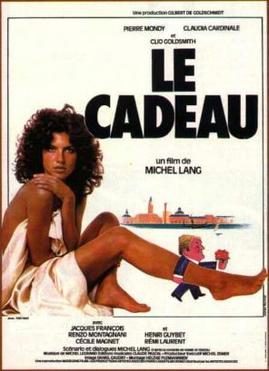
Bankers Also Have Souls (French: Le Cadeau;Italian: Il regalo), also released as The Gift, is a 1982 French and Italian film. It stars Claudia Cardinale.[1] It is based upon the play written by Italo Terzoli and Enrico Vaime, originally brought to success by Gino Bramieri, Valeria Valeri and Paola Tedesco.[2]
Gregoire is retiring after many years with the same bank, and his colleagues surprise him with the gift of a beautiful call girl, Barbara. Thinking she is a conquest, he impersonates the bank president, leading to a comedy of mistaken identities.
While praising the original play, Italian critic Tullio Kezich described the film as “a rancid frozen dish à la Feydeau, stuffed with archaeological gags”.[2]
