


=== Text ===
=== Text ===
!Greek Original
! scope=”col” style=”width:50%;” | Greek Original
!Translation to English
! scope=”col” style=”width:50%;” | English Translation
|-
|-
| valign=”top” |
κατακεχώρισται τὸ ἀντίγραφον. Εὖ οὖν ποιήσεις
κατακεχώρισται τὸ ἀντίγραφον. Εὖ οὖν ποιήσεις
(Ἔτους) δλρ’ Γορπιαίου κβ'{{sfn|Cotton|Wörrle|2007|p=192}}
| valign=”top” |
| valign=”top” |
Ἡλιόδωρος Δορυμένει τῶι ἀδελφῶι χαίρειν· τοῦ ἀπο-
8 δοθέντος ἡμῖν προστάγματος παρὰ τοῦ βασιλέως
περὶ τῶν κατὰ Ὀλυμπιόδωρον ὑποτέτακται τὸ ἀντί-
γραφον. Εὖ οὖν ποιήσεις κατακολουθήσας τοῖς ἐπεσ-
ταλμένοις.
12 (Ἔτους) δλρ’ Γορπιαίου κ{γ}'{{sfn|Cotton|Wörrle|2007|p=192}}
| valign=”top” |
(Ἔτους) δλρ’ Γορπιαίου κβ’{{sfn|Cotton|Wörrle|2007||p=192}}
() {{sfn|Cotton|Wörrle|2007|p=}}
|-
|-
| valign=”top” |
|Ἡλιόδωρος Δορυμένει τῶι ἀδελφῶι χαίρειν· τοῦ ἀπο- δοθέντος ἡμῖν προστάγματος παρὰ τοῦ βασιλέως περὶ τῶν κατὰ Ὀλυμπιόδωρον ὑποτέτακται τὸ ἀντί- γραφον. Εὖ οὖν ποιήσεις κατακολουθήσας τοῖς ἐπεσ- ταλμένοις. (Ἔτους) δλρ’ Γορπιαίου κ{γ}'{{sfn|Cotton|Wörrle|2007||p=192}}
Βασιλεὺς Σέλευκος Ἡλιοδώρωι τῶι ἀδελφῶι χαίρειν·
πλείστην πρόνοιαν ποιούμενοι περὶ τῆς τῶν ὑπο-
|-
|Βασιλεὺς Σέλευκος Ἡλιοδώρωι τῶι ἀδελφῶι χαίρειν· πλείστην πρόνοιαν ποιούμενοι περὶ τῆς τῶν ὑπο- τεταγμένων ἀσφαλείας καὶ μέγιστον ἀγαθὸ[ν] εἶναι νομίζοντες τοῖς πράγμασιν, ὅταν οἱ κατὰ τὴν βασιλείαν ἀδεῶς τοὺς ἑαυτῶν βίους διοικῶ- σιν, καὶ συνθεωροῦντες, ὡς οὐθὲν δύναται μετα- λαμβάνειν τῆς καθηκούσης εὐδαιμονίας ἄνευ
τεταγμένων ἀσφαλείας καὶ μέγιστον ἀγαθὸ[ν]
εἶναι νομίζοντες τοῖς πράγμασιν, ὅταν οἱ κατὰ
τὴν βασιλείαν ἀδεῶς τοὺς ἑαυτῶν βίους διοικῶ-
σιν, καὶ συνθεωροῦντες, ὡς οὐθὲν δύναται μετα-
λαμβάνειν τῆς καθηκούσης εὐδαιμονίας ἄνευ
τῆς τῶν θεῶν εὐμ〈ε〉νείας, ἵνα μὲν τὰ καθιδρυ- μένα κατὰ τὰς ἄλλας σατραπείας ἱερὰ τὰς πατρίο[υς] κομίζηται τιμὰς μετὰ τῆς ἁρμοζούσης θεραπ[είας], [ἐ]ξ ἀρχῆς τυγχάνομεν τεταγμένοι, τῶν δὲ κ[ατὰ] 24 [Κο]ί[λη]ν Συρίαν καὶ Φοινίκην πραγμάτων οὐκ ἐ[χόντων] [τὸν τα]σσόμενον πρὸς τῆι τούτων ἐπιμελ[είαι – ca. 6 -]
τῆς τῶν θεῶν εὐμ〈ε〉νείας, ἵνα μὲν τὰ καθιδρυ-
μένα κατὰ τὰς ἄλλας σατραπείας ἱερὰ τὰς πατρίο[υς]
κομίζηται τιμὰς μετὰ τῆς ἁρμοζούσης θεραπ[είας],
[ἐ]ξ ἀρχῆς τυγχάνομεν τεταγμένοι, τῶν δὲ κ[ατὰ]
[Κο]ί[λη]ν Συρίαν καὶ Φοινίκην πραγμάτων οὐκ ἐ[χόντων]
[τὸν τα]σσόμενον πρὸς τῆι τούτων ἐπιμελ[είαι – ca. 6 -]
μεν ὅτι σωφρόνως πρὸς τὴ[ν —————-]
| valign=”top” |
|}
|}
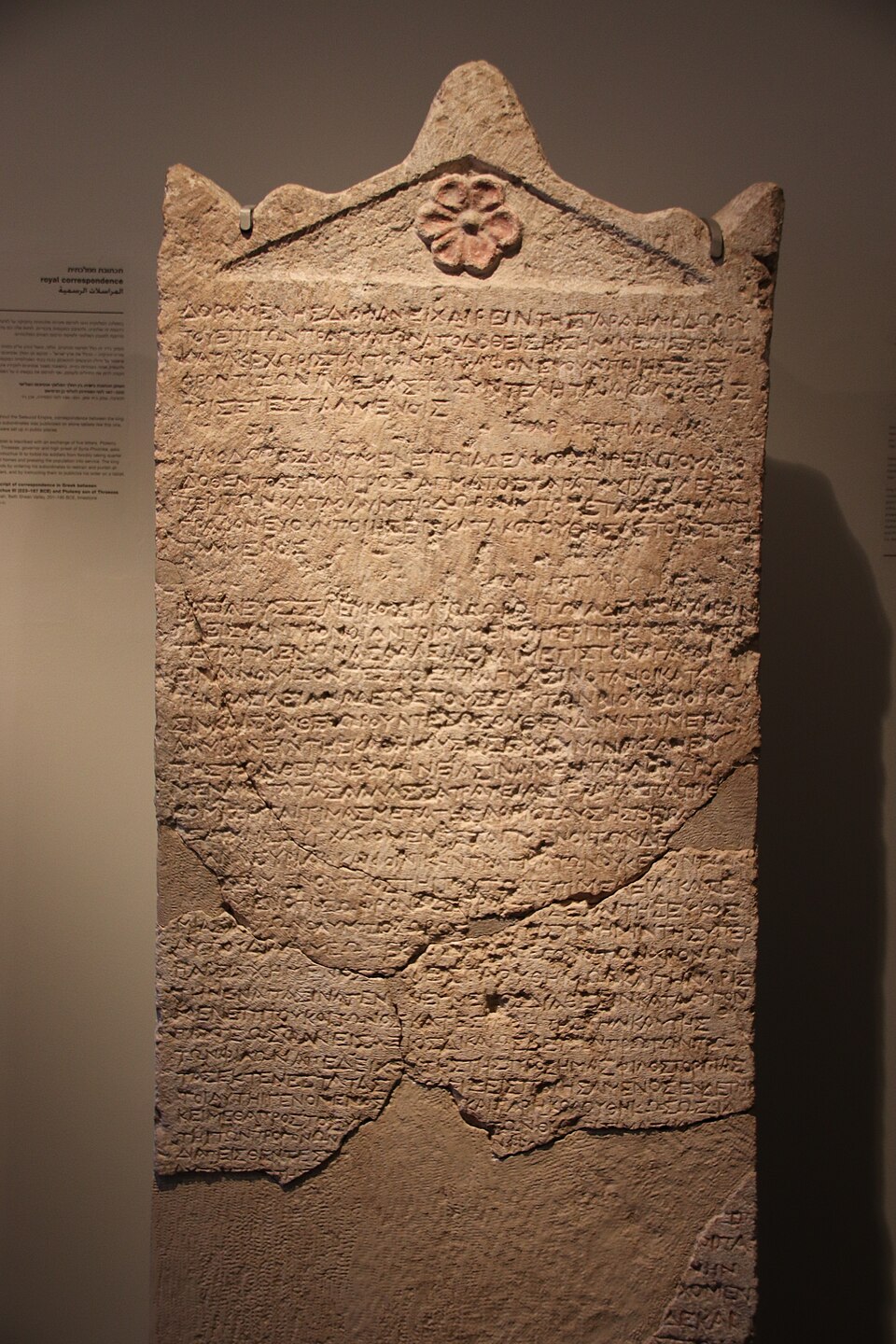
2nd-century BCE Greek inscription from Maresha, Israel
| Heliodorus Stele | |
|---|---|
The reconstructed Heliodorus Stele at the Israel Museum | |
| Type | Stele |
| Material | Limestone |
| Height | 110 cm |
| Width | 57.5 cm |
| Depth | 12.9–16.2 cm |
| Writing | Ancient Greek |
| Created | 178 BCE |
| Discovered | 2005–2006 Subterranean complex #57, Maresha, Israel |
| Discovered by | Ian Stern and Bernie Alpert (excavated fragments) |
| Present location | Israel Museum, Jerusalem |
| Identification | 2006-52/1; 2009-1488/1-3 |
| Culture | Hellenistic (Seleucid) |
The Heliodorus Stele is an inscribed Hellenistic-era stone block discovered in Maresha, Israel. Dating to 178 BCE, its inscription contains three documents in Greek, including two letters from local and regional officials of the Seleucid Empire and a royal ordinance from King Seleucus IV to his prime minister, Heliodorus. Its central theme is the appointment of an individual named Olympiodorus as an overseer or high priest in charge of the sanctuaries in the Seleucid-controlled regions of Coele-Syria and Phoenicia. The appointment granted Olympiodorus control over temple revenues to help the Seleucid Empire pay the massive war indemnities owed to Rome following the Seleucid defeat in the Roman–Seleucid war and the subsequent Treaty of Apamea of 188 BCE.
The stele provides background for the “Heliodorus affair” described in 2 Maccabees 3, which recounts an attempt by a Seleucid official named Heliodorus to confiscate the treasuries of the Temple in Jerusalem. While the inscription confirms Heliodorus as a genuine historical figure, it identifies Olympiodorus—not Heliodorus—as the official tasked with inspecting the temples. Scholars offered two theories to resolve this discrepancy. One suggests that Olympiodorus’s oversight sparked such significant local tension that it required the direct intervention of Heliodorus himself. Alternatively, the author of 2 Maccabees may have simply substituted Olympiodorus with the more famous and phonetically similar Heliodorus.
In any case, the inscription provides evidence of a policy shift within the Seleucid Empire concerning its intervention and fiscal involvement in the sanctuaries under its rule. This shift triggered a decline in relations between the Jews of Judea and the Seleucid authorities, creating a tension that reached its nadir under King Antiochus IV Epiphanes, whose anti-Jewish edicts eventually ignited the Maccabean Revolt in 167 BCE.
The stele is carved from Hebron limestone. It was reconstructed from five pieces: some surfaced through the illegal antiquities trade, while others were discovered during excavations in subterranean complex #57 at Maresha, an important town in classical Idumaea, south of Judea. The upper part is gabled and features a pediment decorated with a red-painted rosette. Above this, there are three acroteria: one positioned in the center and two on the edges.
The main body of the stele (comprising fragments A, B, C, and D) measures 110 cm in height, 57.5 cm in width, and between 12.9 and 16.2 cm in depth. A fifth fragment (E) measures 37 cm by 22 cm. The Greek text was carved by a single stonemason, who used an eight-toothed chisel. The letters in the upper portion of the stele are larger, measuring 1.4 cm in height, compared to those in the lower portion, which measure 1.1 cm. The use of the symbol L as an abbreviation for “year” (ἔτους) is a convention derived from Ptolemaic Egyptian scribal tradition. Traces of red paint, commonly used to highlight characters, were found on all fragments.
To fix the “messy” layout and ensure the Greek text strictly follows the original line breaks of the inscription, I have used the
| Greek Original | English Translation |
|---|---|
Δορυμένης Διοφάνει χαίρειν· τῆς παρὰ Ἡλιοδώρου | Dorymenes to Diophanes greetings. The copy of the letter handed over to us by Heliodoros, who is in charge of the affairs, is enclosed. You will do well, therefore, if you take care that everything is carried out according to the instructions. Year 134 (178 BCE), 22 of the month of Gorpiaios |
Ἡλιόδωρος Δορυμένει τῶι ἀδελφῶι χαίρειν· τοῦ ἀπο- | Heliodoros to Dorymenes his brother, greetings. The copy of the order by the king concerning Olympiodoros handed over to us is placed below. You will do well, therefore, if you follow the instructions. Year 134, 23 (?) of the month of Gorpiaios. |
Βασιλεὺς Σέλευκος Ἡλιοδώρωι τῶι ἀδελφῶι χαίρειν· | King Seleukos to Heliodoros his brother, greetings. Taking the utmost consideration for the safety of our subjects, and thinking it to be of the greatest good for the affairs in our realm when those living in our kingdom manage their lives without fear, and at the same time realizing that nothing can enjoy its fitting prosperity without the good will of the gods, from the outset we have made it our concern to ensure that the sanctuaries founded in the other satrapies receive the traditional honors with the care befitting them. But since the affairs in Koile Syria and Phoinike stand in need of appointing someone to take care of these (i.e. sanctuaries) … Olympiodoros … |
The reconstruction occurred in stages between 2005 and 2006, combining items from the antiquities market with those found in situ. In 2005, Fragment D was found in Room 1 of the complex during a licensed excavation led by Ian Stern and Bernie Alpert. In 2006, Fragments A and B were brought from the antiquities market to the Israel Antiquities Authority for examination, and laboratory tests by Yuval Goren suggested they came from the underground caves of Maresha. Later, in 2006, Fragments C and E were discovered at the excavation site, at the same room where Fragment D was found. It was soon discovered that fragments C and D joined perfectly with the bottom of fragments A and B.
Today, the reconstructed stele is housed in the Israel Museum in Jerusalem, with the catalogue numbers 2006-52/1 and 2009-1488/1-3.
The inscription, dating to mid-summer 178 BCE, includes three documents arranged in reversed chronology. The first is a letter from Dorimanes, the strategos, or general governor of Coele-Syria and Phoenicia, to Diopanes, apparently the governor of Maresha. The second is from Heliodorus, the prime minister (ὁ ἐπὶ τῶν πραγμάτων), to Dorimanes. The last is a royal edict, or prostagma, from King Seleucus IV Philopator to Heliodorus. Through this structure, the inscription unveils the full chain of command in the Seleucid Empire: the King at the top, followed by the prime minister, the district governor, and finally the local official.

The central figure in the inscription, however, is Olympiodorus, a loyal “First Friend” and former chamberlain. According to the inscription, he was appointed to a senior religious-administrative position of High Priest (Archiereus in Greek) or inspector over all the temples in the provinces of Coele-Syria and Phoenicia. This appointment was intended to strengthen royal oversight of temple revenues, likely driven by the Seleucid Empire’s need to pay heavy reparations to the Roman Republic following the Treaty of Apamea, the 188 BCE peace agreement signed after the Seleucid defeat in the Roman–Seleucid war. In the inscription, the king states that the appointment is meant to ensure eukosmia, or good order, and to provide proper supervision for temples that had been left neglected.
Other copies of this royal ordinance exist: one from elsewhere in Maresha and another seemingly from the Phoenician city of Byblos in modern-day Lebanon. However, these are only partial; the Heliodorus Stele remains the most complete copy of the ordinance. An earlier, similar ordinance from Antiochus III dating to 209 BCE, which appointed an individual named Nikanor as the high priest of sanctuaries across Seleucid Asia Minor, was discovered in two copies in both Mysia and Phrygia.
Connection to 2 Maccabees
[edit]
The inscription provides the historical background for the narrative in 2 Maccabees, Chapter 3, supplying an important independent confirmation for a pivotal event leading up to the Maccabean Revolt in Judea that was otherwise attested only in that book. In that chapter, a Seleucid official named Heliodorus is described as a minister sent by Seleucus IV to confiscate funds from the Temple in Jerusalem, an attempt that was miraculously thwarted by divine intervention, through a horsemen and two youths. The inscription confirms Heliodorus as a historical figure and describes him as holding a central position in the Seleucid apparatus. The text also confirms the use of “brother” as a formal way for the king and his ministers to address one another. This style of address appears in the Books of Maccabees and was previously dismissed as an invention by the authors; however, thanks to this inscription, it can now be confirmed as an actual court custom.

More than anything, the mention of a Seleucid official appointed over temples throughout the entire Coele-Syria and Phoenicia region, which included the region of Judea, and in it, the Jerusalem Temple, lends historicity to the account in 2 Maccabees. It serves as the historical context for Heliodorus’s attempted confiscation of Temple. However, while 2 Maccabees identifies Heliodorus as the one who robs the temple, the inscription identifies Heliodorus as the chief minister and Olympiodorus as the temple inspector. There are two primary theories to resolve this discrepancy. The first suggests an escalation: the appointment of Olympiodorus to inspect the temples created tensions between the Jews and the Seleucid authorities, which required a direct expedition by Heliodorus himself. The second option is that Olympiodorus was the official who challenged the Jewish priesthood in Jerusalem, but the author of 2 Maccabees replaced him with the more famous figure of Heliodorus, whose name carries a similar sound.
The inscription provides evidence of the diminishing privileges previously granted by Antiochus III to the Jews of Judea, which had included an autonomous self-rule and financial support for the Jerusalem Temple. It is clear that the appointment of a Seleucid inspector over the temples reduced the autonomy of the Jerusalem priesthood. This administrative act may represent the early stages of a policy shift under Seleucus III, that triggered the decline in relations between the Jewish population and the Seleucid authorities. This decline reached its lowest point under King Antiochus IV Epiphanes, whose invasion of the Jerusalem Temple, confiscation of its funds, and subsequent anti-Jewish persecutions ultimately sparked the Maccabean Revolt.
- Ameling, Walter; Cotton, Hannah M.; Eck, Werner; Ecker, Avner, eds. (2018). “CXXI. Marisa (Maresha, mod. Tell Sandahannah)”. Iudaea / Idumaea: 3325-3978. Corpus Inscriptionum Iudaeae/Palaestinae. Vol. 4. Berlin: De Gruyter. pp. 956–967. ISBN 9783110543643.
- Cotton, Hannah M.; Wörrle, Michael (2007). “Seleukos IV to Heliodoros: A New Dossier of Royal Correspondence from Israel”. Zeitschrift für Papyrologie und Epigraphik. 159: 191–205. JSTOR 20191205.
- Goren, Yuval (2007). “Scientific Examination of a Seleucid Limestone Stele”. Zeitschrift für Papyrologie und Epigraphik. 159: 206–216. JSTOR 20191196.
- Gera, Dov (2009). “Heliodoros, Olympiodoros, and the Temples of Koilê Syria and Phoinikê”. Zeitschrift für Papyrologie und Epigraphik. 169: 125–155.
- Jones, Christopher P. (2009). “The Inscription from Tel Maresha for Olympiodoros”. Zeitschrift für Papyrologie und Epigraphik. 171: 100–104. JSTOR 20756749.
- Stern, Ian (March 2009). “Maresha Inscriptions Provide Context for a Royal Stele in the Israel Museum”. Near Eastern Archaeology. 72 (1): 60–61. doi:10.1086/NEA20697214.
- “Heliodorus Stele (exhibition)”. Israel Museum. 2007.
