


| access-date = 2018-05-23
| access-date = 2018-05-23
}}
}}
== Gene ==
The ABR activator of RhoGEF and GTPase, also symbolized as ABR, gene has a reported 13 [[Alternative splicing|alternatively spliced]] transcript variants.{{Cite web |title=Gene: Abr (ENSMUSG00000017631) – Summary – Mus musculus – Ensembl genome browser 89 |url=http://may2017.archive.ensembl.org/Mus_musculus/Gene/Summary?db=core;g=ENSMUSG00000017631;r=11:76416734-76622314 |access-date=2022-05-03 |website=may2017.archive.ensembl.org}} This gene is found to have ubiquitous [[gene expression|expression]] within 23 [[human tissue]]s, including the heart and brain.{{Cite web |title=ABR ABR activator of RhoGEF and GTPase [Homo sapiens (human)] – Gene – NCBI |url=https://www.ncbi.nlm.nih.gov/gene/29#gene-expression |access-date=2022-05-03 |website=www.ncbi.nlm.nih.gov}} The protein encoded by ABR shares [[sequence homology|homology]] with the [[BCR (gene)|Breakpoint Cluster Region]] (BCR) gene located on [[chromosome 22]] and has shown to share similar protein functions.{{cite journal | vauthors = Cho YJ, Cunnick JM, Yi SJ, Kaartinen V, Groffen J, Heisterkamp N | title = Abr and Bcr, two homologous Rac GTPase-activating proteins, control multiple cellular functions of murine macrophages | journal = Molecular and Cellular Biology | volume = 27 | issue = 3 | pages = 899–911 | date = February 2007 | pmid = 17116687 | pmc = 1800684 | doi = 10.1128/MCB.00756-06 }}
== Function ==
== Function ==
{{See also|RhoGEF|GTPase|botulinum toxin}}
{{See also|RhoGEF|GTPase|botulinum toxin}}
The ABR activator of RhoGEF and GTPase, also symbolized as ABR, gene has a reported 13 [[Alternative splicing|alternatively spliced]] transcript variants.{{Cite web |title=Gene: Abr (ENSMUSG00000017631) – Summary – Mus musculus – Ensembl genome browser 89 |url=http://may2017.archive.ensembl.org/Mus_musculus/Gene/Summary?db=core;g=ENSMUSG00000017631;r=11:76416734-76622314 |access-date=2022-05-03 |website=may2017.archive.ensembl.org}} This gene is found to have ubiquitous [[gene expression|expression]] within 23 [[human tissue]]s, including the heart and brain.{{Cite web |title=ABR ABR activator of RhoGEF and GTPase [Homo sapiens (human)] – Gene – NCBI |url=https://www.ncbi.nlm.nih.gov/gene/29#gene-expression |access-date=2022-05-03 |website=www.ncbi.nlm.nih.gov}} The protein encoded by ABR shares [[sequence homology|homology]] with the [[BCR (gene)|Breakpoint Cluster Region]] (BCR) gene located on [[chromosome 22]] and has shown to share similar protein functions.{{cite journal | vauthors = Cho YJ, Cunnick JM, Yi SJ, Kaartinen V, Groffen J, Heisterkamp N | title = Abr and Bcr, two homologous Rac GTPase-activating proteins, control multiple cellular functions of murine macrophages | journal = Molecular and Cellular Biology | volume = 27 | issue = 3 | pages = 899–911 | date = February 2007 | pmid = 17116687 | pmc = 1800684 | doi = 10.1128/MCB.00756-06 }}
The gene a [[ ]] [[ |]] the | of [ ]. ABR [[ ()|]] [[]] . name=Cho>{{cite journal |=Cho YJ Cunnick JM Yi SJ Kaartinen V Groffen J Heisterkamp N |title=Abr and Bcr, two homologous Rac GTPase-activating proteins, control multiple cellular functions of murine macrophages |journal=Molecular and | =27 |issue=3 |pages= |doi=10.1128/MCB.00756-06 }}
The protein encoded by this gene contains a [[GTPase-activating protein]] domain, a [[protein domain|domain]] found in members of the [[Rho family of GTPases|Rho family]] of [[GTP-binding protein]]. ”In vitro” both ABR and BCR are selective for [[Rac (GTPase)|Rac]] and [[CDC42]]. Despite their “GTPase-activating” domain they actually reduce the activity of Rac.{{cite journal |last1=Cho |first1=YJ |last2=Cunnick |first2=JM |last3=Yi |first3=SJ |last4=Kaartinen |first4=V |last5=Groffen |first5=J |last6=Heisterkamp |first6=N |title=Abr and Bcr, two homologous Rac GTPase-activating proteins, control multiple cellular functions of murine macrophages. |journal=Molecular and cellular biology |date=February 2007 |volume=27 |issue=3 |pages=899-911 |doi=10.1128/MCB.00756-06 |pmid=17116687}}
The ABR is an inhibitor of [[ras-related C3 botulinum toxin substrate 1]] (RAC1), a protein found to influence [[cell growth]], [[cell motility|motility of the cell]], and maintain [[cell adhesion|adhesion]] to neighboring [[epithelial cell]]s.{{Cite web |title=ABR Gene – GeneCards {{!}} ABR Protein {{!}} ABR Antibody |url=https://www.genecards.org/cgi-bin/carddisp.pl?gene=ABR#:~:text=Functions%20as%20an%20important%20negative,RAC1%20activity%20(By%20similarity). |access-date=2022-05-17 |website=www.genecards.org}} Recent papers suggest ABR has [[tumor suppressor]] properties in [[leukemia]] because of its role as a RAC1 inhibitor and is being researched as a potential therapy treatment in leukemia patients.{{Cite journal |last1=Namasu |first1=Carolina Yaeko |last2=Katzerke |first2=Christiane |last3=Bräuer-Hartmann |first3=Daniela |last4=Wurm |first4=Alexander Arthur |last5=Gerloff |first5=Dennis |last6=Hartmann |first6=Jens-Uwe |last7=Schwind |first7=Sebastian |last8=Müller-Tidow |first8=Carsten |last9=Hilger |first9=Nadja |last10=Fricke |first10=Stephan |last11=Christopeit |first11=Maximilian |date=2017-11-28 |title=ABR, a novel inducer of transcription factor C/EBPα, contributes to myeloid differentiation and is a favorable prognostic factor in acute myeloid leukemia |journal=Oncotarget |volume=8 |issue=61 |pages=103626–103639 |doi=10.18632/oncotarget.22093 |issn=1949-2553 |pmc=5732755 |pmid=29262589}} Other studies suggest ABR plays an important role in [[Vestibule of the ear|vestibular]] [[morphogenesis]].{{Cite journal |last1=Kaartinen |first1=Vesa |last2=Nagy |first2=Andre |last3=Gonzalez-Gomez |first3=Ignacio |last4=Groffen |first4=John |last5=Heisterkamp |first5=Nora |date=April 2002 |title=Vestibular dysgenesis in mice lacking Abr and Bcr Cdc42/RacGAPs |journal=Developmental Dynamics|volume=223 |issue=4 |pages=517–525 |doi=10.1002/dvdy.10071 |issn=1058-8388 |pmid=11921339|s2cid=29212113 |doi-access=free }}
The ABR is an inhibitor of [[ras-related C3 botulinum toxin substrate 1]] (RAC1), a protein found to influence [[cell growth]], [[cell motility|motility of the cell]], and maintain [[cell adhesion|adhesion]] to neighboring [[epithelial cell]]s.{{Cite web |title=ABR Gene – GeneCards {{!}} ABR Protein {{!}} ABR Antibody |url=https://www.genecards.org/cgi-bin/carddisp.pl?gene=ABR#:~:text=Functions%20as%20an%20important%20negative,RAC1%20activity%20(By%20similarity). |access-date=2022-05-17 |website=www.genecards.org}} Recent papers suggest ABR has [[tumor suppressor]] properties in [[leukemia]] because of its role as a RAC1 inhibitor and is being researched as a potential therapy treatment in leukemia patients.{{Cite journal |last1=Namasu |first1=Carolina Yaeko |last2=Katzerke |first2=Christiane |last3=Bräuer-Hartmann |first3=Daniela |last4=Wurm |first4=Alexander Arthur |last5=Gerloff |first5=Dennis |last6=Hartmann |first6=Jens-Uwe |last7=Schwind |first7=Sebastian |last8=Müller-Tidow |first8=Carsten |last9=Hilger |first9=Nadja |last10=Fricke |first10=Stephan |last11=Christopeit |first11=Maximilian |date=2017-11-28 |title=ABR, a novel inducer of transcription factor C/EBPα, contributes to myeloid differentiation and is a favorable prognostic factor in acute myeloid leukemia |journal=Oncotarget |volume=8 |issue=61 |pages=103626–103639 |doi=10.18632/oncotarget.22093 |issn=1949-2553 |pmc=5732755 |pmid=29262589}} Other studies suggest ABR plays an important role in [[Vestibule of the ear|vestibular]] [[morphogenesis]].{{Cite journal |last1=Kaartinen |first1=Vesa |last2=Nagy |first2=Andre |last3=Gonzalez-Gomez |first3=Ignacio |last4=Groffen |first4=John |last5=Heisterkamp |first5=Nora |date=April 2002 |title=Vestibular dysgenesis in mice lacking Abr and Bcr Cdc42/RacGAPs |journal=Developmental Dynamics|volume=223 |issue=4 |pages=517–525 |doi=10.1002/dvdy.10071 |issn=1058-8388 |pmid=11921339|s2cid=29212113 |doi-access=free }}
=== Knockout phenotype ===
Double-knockout of ABR and BCR ”in vitro” causes macrophage overactivation. Double-knockout of ABR and BCR in mice lead to dysfunctional [[astroglia]] and abnormal postnatal development of the [[cerebellum]].{{cite journal |last1=Kaartinen |first1=Vesa |last2=Gonzalez-Gomez |first2=Ignacio |last3=Voncken |first3=Jan Willem |last4=Haataja |first4=Leena |last5=Faure |first5=Emmanuelle |last6=Nagy |first6=Andre |last7=Groffen |first7=John |last8=Heisterkamp |first8=Nora |title=Abnormal function of astroglia lacking Abr and Bcr RacGAPs |journal=Development |date=1 November 2001 |volume=128 |issue=21 |pages=4217–4227 |doi=10.1242/dev.128.21.4217}}
== References ==
== References ==
Protein-coding gene in the species Homo sapiens
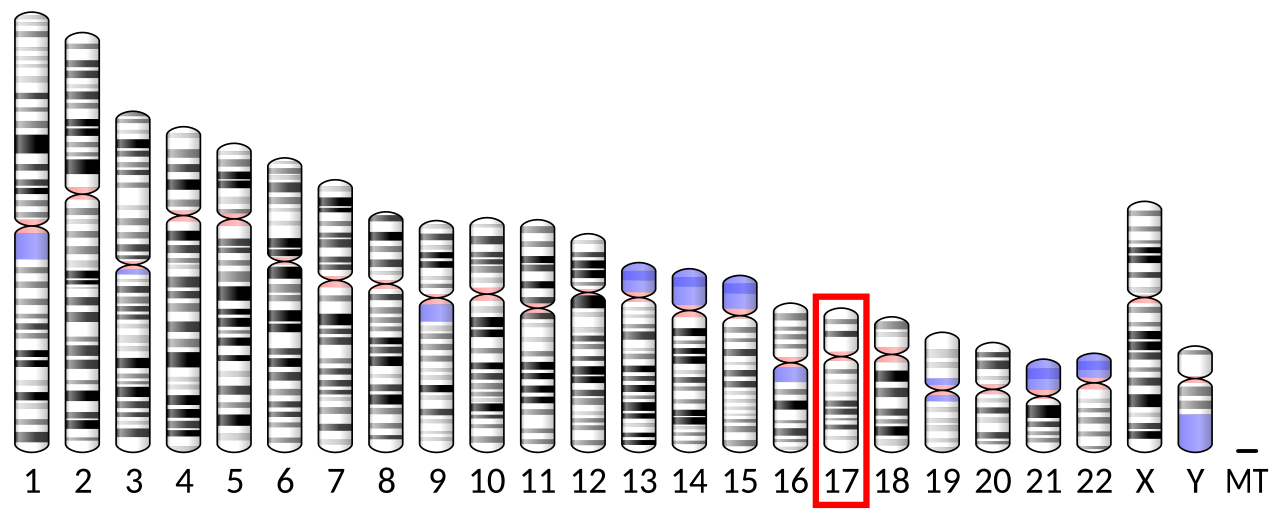
Active breakpoint cluster region-related protein is a protein that in humans is encoded by the ABR gene.
[5]
The ABR activator of RhoGEF and GTPase, also symbolized as ABR, gene has a reported 13 alternatively spliced transcript variants.[6] This gene is found to have ubiquitous expression within 23 human tissues, including the heart and brain.[7] The protein encoded by ABR shares homology with the Breakpoint Cluster Region (BCR) gene located on chromosome 22 and has shown to share similar protein functions.[8]
The protein encoded by this gene contains a GTPase-activating protein domain, a domain found in members of the Rho family of GTP-binding protein. In vitro both ABR and BCR are selective for Rac and CDC42. Despite their “GTPase-activating” domain they actually reduce the activity of Rac.[9]
The ABR is an inhibitor of ras-related C3 botulinum toxin substrate 1 (RAC1), a protein found to influence cell growth, motility of the cell, and maintain adhesion to neighboring epithelial cells.[10] Recent papers suggest ABR has tumor suppressor properties in leukemia because of its role as a RAC1 inhibitor and is being researched as a potential therapy treatment in leukemia patients.[11] Other studies suggest ABR plays an important role in vestibular morphogenesis.[12]
Double-knockout of ABR and BCR in vitro causes macrophage overactivation.[9] Double-knockout of ABR and BCR in mice lead to dysfunctional astroglia and abnormal postnatal development of the cerebellum.[13]
- ^ a b c ENSG00000278741, ENSG00000276016 GRCh38: Ensembl release 89: ENSG00000159842, ENSG00000278741, ENSG00000276016 – Ensembl, May 2017
- ^ a b c GRCm38: Ensembl release 89: ENSMUSG00000017631 – Ensembl, May 2017
- ^ “Human PubMed Reference:”. National Center for Biotechnology Information, U.S. National Library of Medicine.
- ^ “Mouse PubMed Reference:”. National Center for Biotechnology Information, U.S. National Library of Medicine.
- ^ “Entrez Gene: ABR, RhoGEF and GTPase activating protein”. Retrieved 2018-05-23.
- ^ “Gene: Abr (ENSMUSG00000017631) – Summary – Mus musculus – Ensembl genome browser 89”. may2017.archive.ensembl.org. Retrieved 2022-05-03.
- ^ “ABR ABR activator of RhoGEF and GTPase [Homo sapiens (human)] – Gene – NCBI”. www.ncbi.nlm.nih.gov. Retrieved 2022-05-03.
- ^ Cho YJ, Cunnick JM, Yi SJ, Kaartinen V, Groffen J, Heisterkamp N (February 2007). “Abr and Bcr, two homologous Rac GTPase-activating proteins, control multiple cellular functions of murine macrophages”. Molecular and Cellular Biology. 27 (3): 899–911. doi:10.1128/MCB.00756-06. PMC 1800684. PMID 17116687.
- ^ a b Cho YJ, Cunnick JM, Yi SJ, Kaartinen V, Groffen J, Heisterkamp N (February 2007). “Abr and Bcr, two homologous Rac GTPase-activating proteins, control multiple cellular functions of murine macrophages”. Molecular and cellular biology. 27 (3): 899–911. doi:10.1128/MCB.00756-06. PMID 17116687.
- ^ “ABR Gene – GeneCards | ABR Protein | ABR Antibody”. www.genecards.org. Retrieved 2022-05-17.
- ^ Namasu CY, Katzerke C, Bräuer-Hartmann D, Wurm AA, Gerloff D, Hartmann JU, Schwind S, Müller-Tidow C, Hilger N, Fricke S, Christopeit M (2017-11-28). “ABR, a novel inducer of transcription factor C/EBPα, contributes to myeloid differentiation and is a favorable prognostic factor in acute myeloid leukemia”. Oncotarget. 8 (61): 103626–103639. doi:10.18632/oncotarget.22093. ISSN 1949-2553. PMC 5732755. PMID 29262589.
- ^ Kaartinen V, Nagy A, Gonzalez-Gomez I, Groffen J, Heisterkamp N (April 2002). “Vestibular dysgenesis in mice lacking Abr and Bcr Cdc42/RacGAPs”. Developmental Dynamics. 223 (4): 517–525. doi:10.1002/dvdy.10071. ISSN 1058-8388. PMID 11921339. S2CID 29212113.
- ^ Kaartinen V, Gonzalez-Gomez I, Voncken JW, Haataja L, Faure E, Nagy A, Groffen J, Heisterkamp N (1 November 2001). “Abnormal function of astroglia lacking Abr and Bcr RacGAPs”. Development. 128 (21): 4217–4227. doi:10.1242/dev.128.21.4217.
This article incorporates text from the United States National Library of Medicine, which is in the public domain.
