


{{Main|Treatment of bipolar disorder}}
{{Main|Treatment of bipolar disorder}}
* [[Mood stabilizer]]s{{snd}} medication that reduces mood swings and allows the user to experience a more typical range of moods
* [[Mood stabilizer]]s{{snd}} medication that reduces mood swings and allows the user to experience a more typical range of moods
* [[Anticonvulsant]]s
* [[Anticonvulsant]]s
* [[Carbamazepine]]
* [[Carbamazepine]]
* [[Gabapentin]]
* [[Gabapentin]]
* [[Lamotrigine]] (Lamictal)
* [[Lamotrigine]] (Lamictal)
* [[Oxcarbazepine]]
* [[Oxcarbazepine]]
* [[Topiramate]]
* [[Topiramate]]
* [[Valproic acid]], [[sodium valproate]], and [[valproate semisodium]]
* [[Valproic acid]], [[sodium valproate]], and [[valproate semisodium]]
* [[Lithium (medication)]]{{snd}} [[lithium carbonate]] and [[lithium citrate]]
* [[Lithium (medication)]]{{snd}} [[lithium carbonate]] and [[lithium citrate]]
* [[Anxiety]]
* [[]]
* [[Alprazolam]] (Solanax and Xanax)
* [[Alprazolam]] (Solanax and Xanax)
* [[List of benzodiazepines]]
* [[List of benzodiazepines]]
== Non-pharmaceutical treatment of bipolar disorder ==
== Non-pharmaceutical treatment of bipolar disorder ==
* [[Clinical psychology]]
* [[Clinical psychology]]
* [[Psychotherapy]]
* [[Psychotherapy]]
* [[Transcranial magnetic stimulation]]
* [[Transcranial magnetic stimulation]]
== History of bipolar disorder ==
== History of bipolar disorder ==
Overview of and topical guide to bipolar disorder
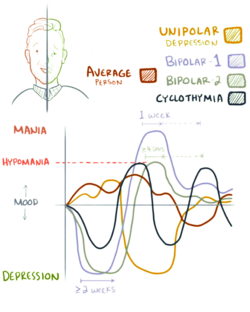
Bipolar disorder is a mental disorder with cyclical periods of depression and periods of elevated mood.[1] The elevated mood is significant and is known as mania, a severe elevation that can be accompanied by psychosis in some cases, or hypomania, a milder form of mania. During mania, an individual behaves or feels abnormally energetic, elated, or irritable.[1] Individuals often make poorly thought out decisions with little regard to the consequences. The need for sleep is usually reduced during manic phases.
During periods of depression, there may be crying, a negative outlook on life, and poor eye contact with others.[1] The risk of suicide among those with the illness is high at greater than 6 percent over 20 years, while self-harm occurs in 30–40 percent.[1] Other mental health issues such as anxiety disorders and substance use disorder are commonly associated. Also known as manic depression. People with bipolar disorder experience the whole spectrum of emotional feelings from unimaginable grief to full blown euphoria whereas normal people experience only a section of the spectrum of emotional feelings somewhere between extreme grief and extreme happiness.[2][3]
What categories does bipolar disorder fall under?
[edit]
Bipolar disorder can be described as all of the following:
- Disorder –
- Mental disorder – functional abnormality or disturbance characterized by a behavioral or mental pattern that may cause suffering or a poor ability to function in life. Such features may be persistent, relapsing and remitting, or occur as a single episode.
- More specifically, bipolar disorder can be characterized by extreme mood swings, ranging from extreme peaks or “highs” of happiness, otherwise known as hypomania, to heightened lows of sadness and depression.[4]
- Mental disorder – functional abnormality or disturbance characterized by a behavioral or mental pattern that may cause suffering or a poor ability to function in life. Such features may be persistent, relapsing and remitting, or occur as a single episode.
Bipolar spectrum –
- Bipolar I – bipolar disorder with at least one manic episode (with or without psychotic features), possibly with hypomanic and/or depressive episodes as well
- Psychotic features – psychosis experienced in some cases of Bipolar I disorder, typically during mania or a severe depressive episode
- Bipolar II – bipolar disorder categorized by depressive episodes and at least one hypomanic episode, no manic episode experienced
- Cyclothymia – a milder form of bipolar disorder with predominantly depressive symptoms and some symptoms of hypomania, does not meet diagnostic severity of bipolar I or II
- Dysthymia – akin to depression, with chronic symptoms
- Major depressive disorder – a mood disorder involving low mood, low energy, poor self-esteem, lack of interest in enjoyable activities, and/or aches and pains
- Schizoaffective disorder – cyclical mood episodes combined with psychosis; has subtypes: bipolar type and depressive type
- Mania – a state of hyperactivity, heightened mood (euphoric or irritable), low sleep, pressured speech, grandiosity, and/or racing thoughts; may include psychotic features like delusions or hallucinations
- Mixed affective state – a state with traits of both mania and depression (e.g. irritability, low mood, suicidality, and racing thoughts at the same time)
- Hypomania – an episode of elevated mood, similar to mania with milder symptomatic severity[5]
- Major depressive episode – a mood episode with major depressive symptoms
Symptoms of bipolar disorder
[edit]
Signs typical of mania
[edit]
- Delusion – fixed belief that cannot be changed despite reason or evidence, not explained by common cultural beliefs
- Hallucination – perceiving something that is not actually present
- Insomnia – difficulty falling and/or staying asleep
- Pressured speech – rapid, erratic, and/or frenzied speech that can be difficult for others to understand and interrupt
- Psychosis – inability to distinguish between reality and fantasy
- Racing thoughts – rapid thinking, sometimes experienced as distracting or distressing[6]
Signs typical of depression
[edit]
- Anhedonia – reduced ability to experience pleasure
- Dysphoria – a state of profound unhappiness or discomfort
- Hypersomnia – excessive sleeping and/or sleepiness
- Self harm – causing intentional pain or injury to the body, often as self-punishment or emotional release
- Suicidal ideation – considering committing suicide
Treatment of bipolar disorder
[edit]

Non-pharmaceutical treatment of bipolar disorder
[edit]
History of bipolar disorder
[edit]
- Emil Kraepelin – introduced the dichotomy between ‘manic-depressive insanity’ and ‘dementia praecox’, what we later know as bipolar disorder and schizophrenia.
- Karl Leonhard – introduced the terms ‘bipolar’ and ‘unipolar’.
- John Cade – discovered lithium as a medicine in Australia in 1949.
- Mogens Schou – completed first controlled study on use of lithium in bipolar disorder treatment.
- Frederick K. Goodwin – was the former director of the National Institute of Mental Health.
- Kay Redfield Jamison[7] – wrote the main textbook on bipolar disorder together with Frederick Goodwin, Manic-Depressive Illness: Bipolar Disorders and Recurrent Depression.
- ^ a b c d Anderson IM, Haddad PM, Scott J (Dec 27, 2012). “Bipolar disorder”. BMJ (Clinical Research Ed.). 345 e8508. doi:10.1136/bmj.e8508. PMID 23271744. S2CID 22156246.
- ^ “Bipolar Disorder”. National Institute of Mental Health (NIMH). Retrieved 2023-07-28.
- ^ “How Does Bipolar Disorder Affect Thinking”. Retrieved 30 January 2025.
- ^ “Bipolar disorder – Symptoms and causes”. Mayo Clinic. Retrieved 2025-03-06.
- ^ Angst, Jules (Mar 2007). “The bipolar spectrum”. The British Journal of Psychiatry. 190 (3): 189–191. doi:10.1192/bjp.bp.106.030957. ISSN 0007-1250.
- ^ a b Jain, Ankit; Mitra, Paroma (2025), “Bipolar Disorder”, StatPearls, Treasure Island (FL): StatPearls Publishing, PMID 32644424, retrieved 2026-01-19
- ^ Passos, Ives Cavalcante; Berk, Michael; Kapczinski, Flavio (2025-05-20). Bipolar Disorder: An Evidence-Based Clinical Guide. Springer Nature. ISBN 978-3-031-85519-1.
