


The reaction from the U.S. men’s national team players in Times Square was caught by some video cameras.
Captain Tim Ream and goalkeepers Matt Turner and Matt Freese all looked at each other when Australia was drawn as the U.S.’s first opponent. Freese whipped his head toward Turner, then nodded. The interaction was one of satisfaction and intrigue.
Australia wasn’t just an opponent those players might feel confident to match up against, it was one they had just played in October in Colorado.
The World Cup draw continued in much the same fashion. The U.S. will face another friendly opponent, Paraguay, which the Americans beat in November, in their first group game. Another 2025 friendly opponent, Turkey, could be the final team in their group if it emerges from a European qualifying playoff. Taking it even further, an elimination clash with March 2026 opponent Belgium could beckon in the round of 16 or the round of 32, depending on group finishing position.
U.S. Soccer officials purposely went about crafting the 2025 calendar with an aim to play World Cup-bound opponents from different confederations. They hardly could have believed that two, and maybe all three, of those teams would be in their group.
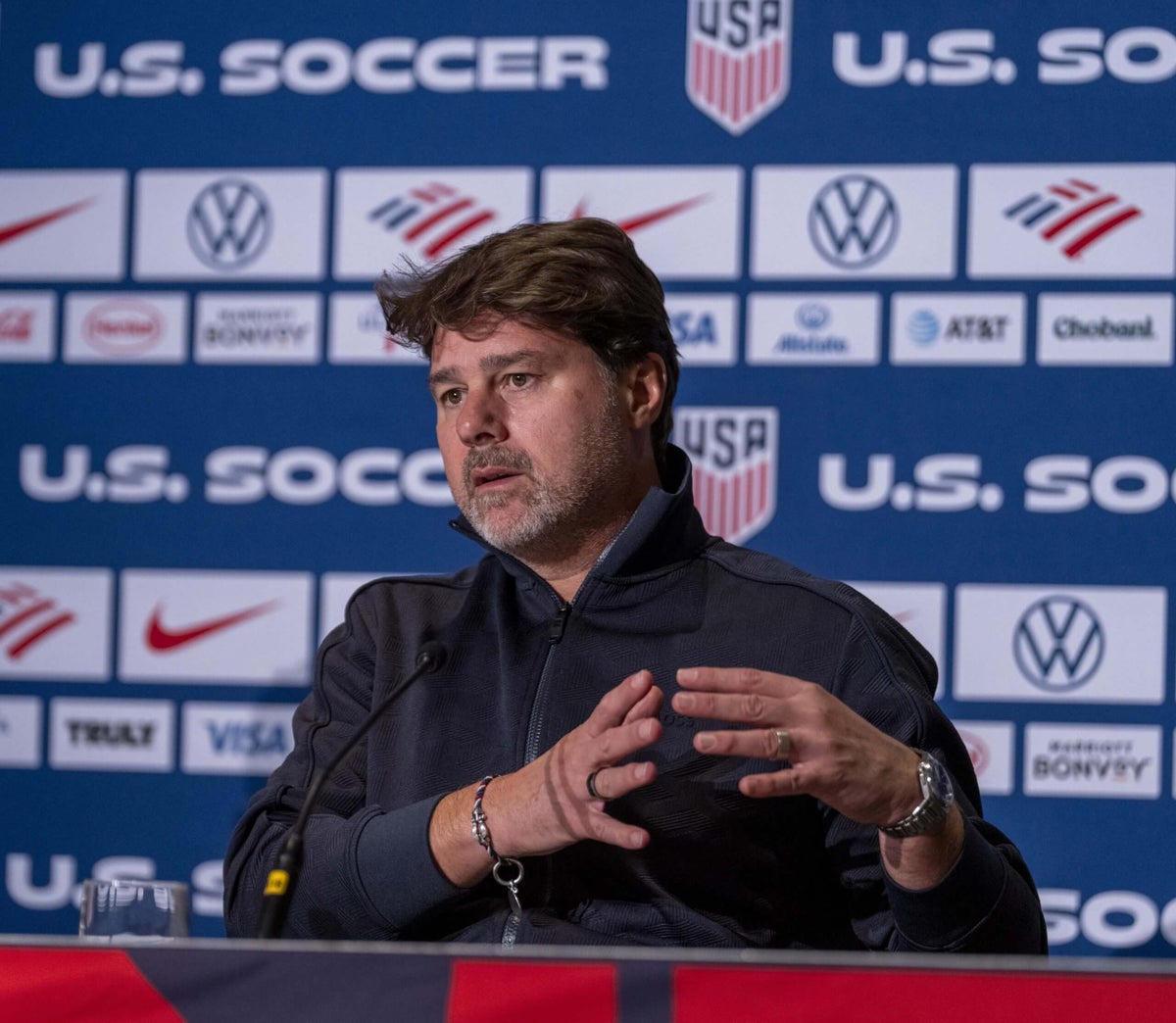
“It means less work,” Pochettino said only half-jokingly after the draw at the Kennedy Center. “Because we’ve already done the homework, because it’s fresh when we played in Denver against Australia and Paraguay in Philadelphia. But, by the way, (there are) still six months (until the World Cup). We need to update everything. And we know them, but they know us.”
There are, of course, both positives and negatives to familiarity with an opponent.
Like Pochettino said, while the U.S. may now have a better understanding of Australia and Paraguay’s strengths and weaknesses, the reverse is also true. It’s important, too, not to let a friendly result dictate what you might expect from the same opponent at a World Cup. The bright lights of that stage will hit differently.
Arda Guler (left) and Oguz Aydin celebrate during Turkey’s victory over the USMNT in June. (Stephen Nadler / ISI Photos / USSF / Getty Images)
“We’ve played potentially all three of these teams in the last six months, but that can be a little bit of a false sense of security,” Ream said in a press conference after the draw. “We need to make sure that that we’re preventing that kind of security and safety feeling from setting in. We have have enough guys with enough experience that know how to keep pushing each other and keep pushing the team in the right direction.”
There is also a good chance the teams will look different in June than they did in October and November, respectively.
“These two games are going to be a good reference for us to start to scout and to see and analyze the two teams, but I think the reality is that the circumstances will change,” Pochettino said. “That is why it’s going to be a completely different game and maybe with different rosters or different players, or (different) starting XIs. It’s still six months (until World Cup camp). Teams can change systems. We need to be aware about that. That is why it will be a good reference for us, but also for them. … I don’t believe that it will be a good advantage or a disadvantage. I think it’s only a reference.”
It may also be helpful that some advance scouting work already went into both Australia and Paraguay, because Pochettino pointed out that the U.S. now has six teams to scout rather than three since its final group opponent will come out of a four-team playoff in Europe. The U.S. advance staff will provide reports on all four teams — Turkey, Romania, Slovakia and Kosovo — ahead of the March playoff.
“The analysts start to work now because we cannot wait until March and then start to work,” Pochettino said. “No, we need to be ready from now.”

Things got heated during the USMNT’s friendly victory over Australia in October. (John McGloughlin / Icon Sportswire / Getty Images)
Coincidentally, it’s not the first time the U.S. has faced familiar opponents leading into a home World Cup.
The U.S. played Switzerland in January 1994 and Romania in February 1994 before facing both in the group stage at the 1994 World Cup. The hosts had also faced Colombia twice in between 1990 and 1994 World Cups (one game apiece in 1992 and 1993), losing both times to extend a losing streak against Los Cafeteros to six entering ’94.
“Knowing a team is always better than not knowing a team,” U.S. 1994 World Cup center back Marcelo Balboa told The Athletic. “The only team we didn’t really want to play when we went through the draw was Colombia, because we faced Colombia a bunch of times and it just didn’t work out for us. We never beat them. We always felt like they were a much superior team. They just outplayed us every time. We tried and we fought and we scratched, but we could never find a way to beat them.”
The U.S., of course, did beat Colombia in the World Cup. The hosts lost to Romania, 1-0, after also losing to them in that February friendly and drew the Swiss with the same 1-1 scoreline in both the friendly and the World Cup.
The advantage from 1994 was arguably bigger three decades ago than it is now. There was far less video available, and so the U.S. felt like it took a lot away from seeing a team up close.
“You get a sense of how they’re going to play their system, which was important for us, since we didn’t have video,” Balboa said. “Set pieces, we kind of already had an idea of what both teams were going to do on set pieces. … Playing them kind of gave us a little bit of a knowledge of what we were going to expect.”
This U.S. team will not be lacking in video of the opponents, even down to breakdowns of opponents’ tendencies at the club level.
Balboa, like Pochettino, also pointed out that so much changed between the friendly and the World Cup. Both teams played different lineups. And the U.S. felt much more pressure to emerge from the group.

The United States played Romania at the 1994 World Cup after having met them in a friendly months earlier. (Richard Mackson / Sports Illustrated / Getty Images)
During the lead up to the World Cup draw in Washington, D.C., last week, Brazilian legend Dunga told Balboa the U.S. was one of the toughest match-ups for Brazil in 1994 because they understood the fight the Americans would bring with an entire country behind them. For the 2026 team, it will be more critical to match that fight — and the energy of being a home nation — to do something special in the tournament, rather than leaning on any advance scouting knowledge.
“I think that for ourselves, no matter who we drew in the group, we were going to have that belief that we could make a run and do something special,” U.S. midfielder Tyler Adams said on Friday. “Just having the draw in general, now the excitement grows and it makes it feel more real.
“For this group, the anticipation was obviously a long time coming to play on home soil. We still have six months more to prepare. There’s no easy game in the World Cup. … For us moving forward, we need to continue to prepare in the right way.”
